
Why a Tree Management Plan Is a Smart Investment for Your Property
Understanding how a phased, budget-friendly tree management plan protects your property and your wallet, with wildfire and insurance compliance built right in. Written by ISA Certified Arborists at Foothill Forest Care.
Most people think about their trees twice a year. Once when a limb is hanging too low over the driveway, and once after a storm drops something on a fence. This reactive approach feels normal until the bill arrives, or worse, until an insurance claim reminds you that you were warned.
Whether you manage a homeowners association, a commercial property, or you're a homeowner in the Sierra Foothills, the trees on your land represent both an asset and a liability. The difference between those two outcomes is a combination of planning and budgeting.
A systematic Tree Management Plan is an approach that turns unpredictable tree costs into a manageable, documented, budget-friendly maintenance schedule. It also happens to satisfy the wildfire and insurance documentation requirements that carriers and local agencies increasingly expect, but the real win is what it does for your wallet. Here is what that looks like in practice.
A Tree Management Plan Saves You More Money Than Any Single Tree Service Ever Could
Emergency tree work is even more expensive. Reactive removals, storm damage cleanup, and last-minute hazard mitigation cost two to three times more than the same work scheduled in advance. For an HOA or commercial property with dozens or hundreds of trees, that difference compounds quickly across a fiscal year. For a homeowner, it is the difference between a planned expense and a financial gut punch.
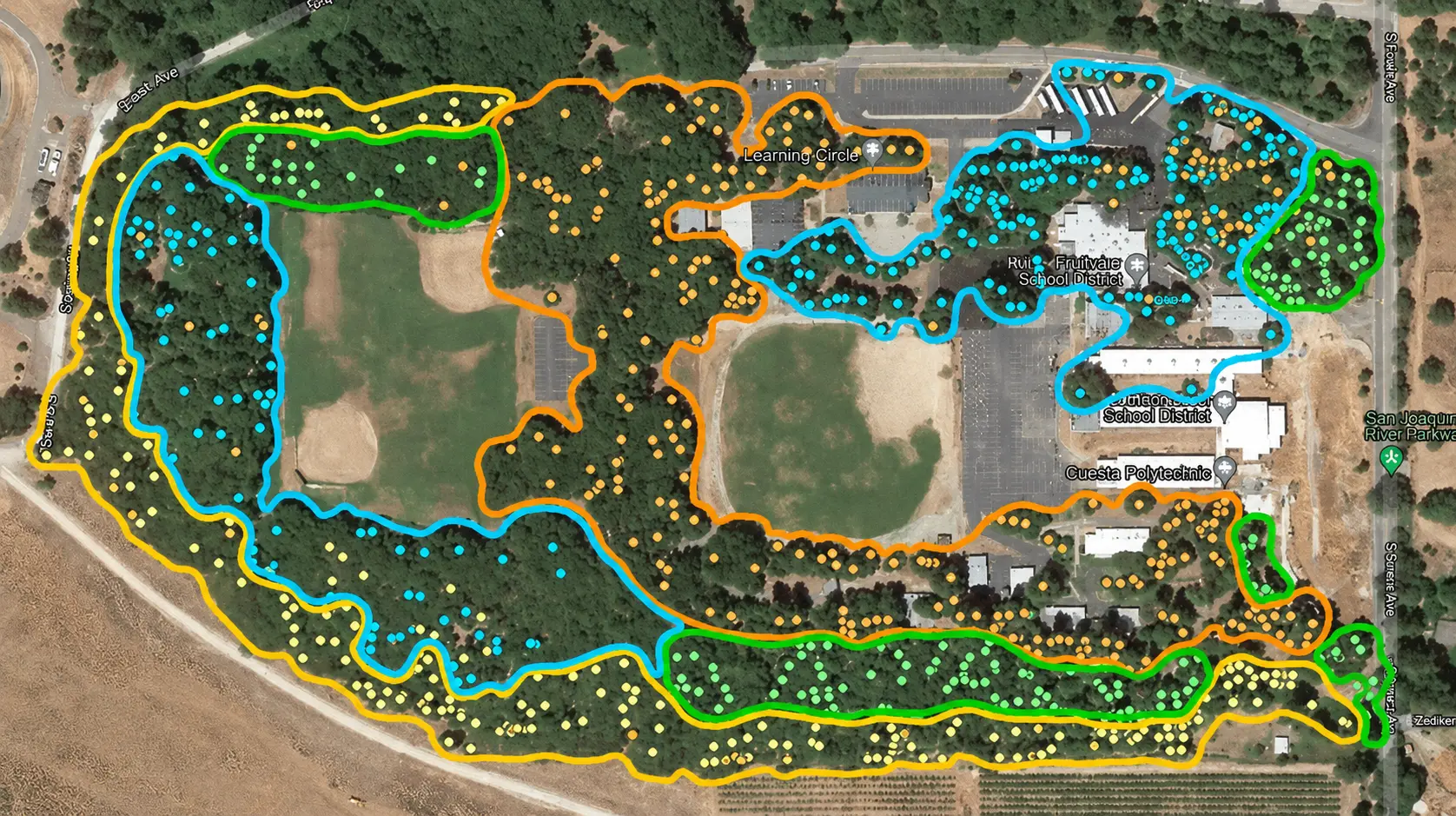
A Tree Management Plan is a structured, long-term (1-5-year) strategy developed by a certified arborist that begins with a complete tree inventory of your property. Every tree gets catalogued by species, size, condition, risk rating, and recommended care timeline. That inventory becomes your financial roadmap.
With that roadmap in hand, you, your board, or your facilities team can prioritize the highest-risk trees before they become emergency removals, schedule pruning, treatments, and inspections across the year so costs are predictable and spread out, and avoid budget spikes that catch homeowners or boards off guard mid-year.
Stop Paying Emergency Prices for Tree Work
Reactive tree work costs two to three times more than the same work planned in advance. A Tree Management Plan replaces that unpredictable cycle with a documented, prioritized schedule your budget can actually accommodate.
- Complete tree inventory by species, size, and risk rating
- Priority list ranked by actual hazard level
- 1-5-year cost roadmap for boards and property managers
- No more mid-year budget surprises
That same inventory also reveals something most commercial properties do not expect: not every tree on the list needs a professional crew. For lower-risk trees that simply need routine pruning from the ground, Foothill Forest Care offers training for your existing maintenance staff, so your team can handle that ongoing work in-house. That leaves your budget free to bring in a professionally trained tree trimming crew only for the trees that are flagged as high-risk, the ones that genuinely require climbing, rigging, or specialized equipment. For a commercial property looking at a five-year maintenance plan, that distinction alone can meaningfully change what the plan costs.
The plan is not a one-time product. It is a living document that gets updated as your trees change and your priorities shift. That continuity is exactly what separates proactive property management from the reactive cycle most properties are stuck in, and it is the foundation everything else in this article builds on.
A Monthly Tree Care Fund Means Cost Never Has to Be the Reason You Wait
Knowing you need a Tree Management Plan and being able to pay for one are two different things, and we want to be honest about that instead of glossing over it.
Foothill Forest Care offers a monthly tree care fund built specifically for homeowners. Instead of facing one large bill when your trees need attention, you pre-pay a manageable amount each month into a dedicated fund tied to your property. Once enough has built up to tackle your highest-priority tree or your next scheduled phase of work, that work gets completed using funds you have already set aside. Think of it as planning ahead for tree care the same way you would plan ahead for a roof or a major appliance, except this keeps your trees healthy and your property protected the entire time you are saving.
What if your tree care bill was never a surprise again? That is exactly what this program is designed to do.
How the Monthly Tree Care Fund Works
- An ISA-Certified Arborist meets you at your property and walks the land with you
- You receive a clear estimate for top-priority work and each coming phase
- Pre-pay whatever fits your monthly budget toward that phase
- Once funded, that phase gets scheduled and completed
- Move on to the next priority at your own pace
No large upfront bill. No skipping necessary tree care because the timing is wrong. Just steady, documented progress on a schedule that works for your household.
Here is how the monthly tree care fund works in practice for residential customers: One of our ISA-Certified Arborists meets you at your property, walks the land with you, and explains exactly what they find and which areas should be prioritized first. From there, you receive a clear estimate for the top-priority tree work and additional estimates for each coming phase of your Tree Management Plan. Rather than paying for an entire phase upfront, you contribute whatever amount fits your budget each month, building toward the cost of that phase at your own pace. Once your contributions cover the work, that phase gets scheduled and completed, and you move on to the next priority on your list.
Commercial properties and HOAs already tend to work within an existing annual maintenance budget, and the same phased logic applies without needing a new program. During the initial assessment, our ISA-Certified Arborists identify which trees on your property genuinely require a professionally trained tree crew, the high-risk trees that need climbing, rigging, or specialized equipment, and which lower-risk trees simply need routine pruning that your existing maintenance staff can learn to handle. We scope your Tree Management Plan around that distinction, matching what your existing budget allows each month or each quarter and prioritizing the trees that need professional attention first, so your board or facilities team sees consistent, documented progress without a surprise expense derailing the year.
The Same Plan That Saves You Money Also Satisfies Wildfire and Insurance Requirements
Here is where a budget-friendly Tree Management Plan does double duty. California Public Resource Code 4291 requires 100 feet of defensible space around homes and structures, and insurance carriers are paying closer attention to that requirement than they were even five years ago. Some homeowners are receiving notices that read like an all-or-nothing ultimatum: clear it all, or risk your policy. A documented, phased Tree Management Plan is exactly what lets you respond to that pressure without facing one overwhelming project cost.
Your insurance company sent a notice. Here is how to respond without panic: start with the zone closest to your home, document every step, and let your Tree Management Plan do the rest.
The 100 feet breaks down into three zones, and Foothill Forest Care arborists already use this structure when assessing your property. Zone 0 is the immediate zone, the five feet closest to your home, where fire embers most often ignite a structure. Priority here includes removing dead plants, leaves, and debris, and managing mulch and vegetation near your foundation.
Zone 1 is the lean and green zone, running from five to thirty feet out, where selective pruning, ladder fuel removal, and reduced plant density prevent flames from reaching your home. Zone 2 is the reduced fuel zone, extending from thirty to one hundred feet, where brush clearing, thinning overcrowded trees, and strategic fuel spacing slow fire down dramatically.
The Three Defensible Space Zones
California Public Resource Code 4291 requires 100 feet of defensible space around every home and structure. Foothill Forest Care arborists already use this zone structure when assessing your property, and your Tree Management Plan is built around it.
Zone 0 — Immediate Zone (0–5 ft)
Fire embers most often ignite homes in this zone. Priority: removing dead plants, leaves, and debris, managing mulch and vegetation near your foundation, and identifying tree limbs or materials that pose an ignition risk.
Zone 1 — Lean & Green Zone (5–30 ft)
Spacing and structure prevent flames from reaching your home. Work here includes selective pruning of trees and shrubs, removing ladder fuels, and reducing plant density while keeping your landscaping attractive.
Zone 2 — Reduced Fuel Zone (30–100 ft)
Fire slows dramatically when fuel loads are reduced at this distance. This zone involves brush clearing and mowing, removing dead or dying vegetation, thinning overcrowded trees, and strategic fuel spacing for long-term safety.
Your Trees Are an Asset or a Liability
The difference is a plan. A documented, phased approach that addresses Zone 0 first naturally aligns with both your budget and your insurance carrier's expectations. You are not choosing between affordable tree care and wildfire compliance.
For HOA boards: Board members have a fiduciary responsibility to manage community assets, and a documented Tree Management Plan gives your board a defensible record of decisions made on the basis of expert, certified recommendations, not whoever complained at the last meeting.
Because your Tree Management Plan already prioritizes your highest-risk trees, addressing Zone 0 first naturally aligns with both your budget and your insurance carrier's expectations. You are not choosing between affordable tree care and wildfire compliance. A well-built plan gives you both at the same time, and our monthly fund option will make that even more accessible for homeowners working through these requirements.
For HOA boards, this is also a governance issue. Board members have a fiduciary responsibility to manage community assets, and a documented Tree Management Plan gives boards a defensible record of decisions made on the basis of expert, certified recommendations rather than whoever complained at the last meeting.
Working With a Local, ISA-Certified Arborist Team Is What Makes the Plan Actually Work
A plan is only as good as the team behind it. That means showing up on schedule, documenting everything, and knowing your property well enough to catch problems before they cost you.
ISA Certification, granted by the International Society of Arboriculture, means your arborist has demonstrated competency in tree biology, risk assessment, pruning science, and tree preservation. It is the standard insurance carriers, permit agencies, and litigation experts look to when evaluating whether tree care was done right.
For commercial properties, a Tree Management Plan typically includes quarterly visits for routine pruning, debris cleanup, and hazard monitoring, plus annual written evaluations suitable for HOA records, insurance requirements, or municipal review.
What You Get With a Local Team That Knows Your Property
- Transparent digital reporting after every visit
- Mapped tree inventories your board can actually use
- A single point of contact who knows your property by name
- Written records suitable for insurance carriers and county inspectors
- Continuity across years, not a fresh crew every season
For residential customers, an annual visit is usually enough to track progress, catch developing problems early, and keep your plan current. A certified arborist notices things a homeowner will not: a subtle change in leaf color, early disease, a stressed root system. Caught early, those issues are treatable. Left alone, they become structural hazards that cost significantly more to address.
One of the most consistent frustrations we hear from property managers who have cycled through multiple tree companies: crews do not show up, reports are vague, and nobody actually knows the property. A local, ISA-Certified team solves all three. You get continuity, accountability, and a team that remembers which tree they flagged three years ago, because they were the ones who flagged it.
The Bottom Line
Reactive tree care will always cost more than programmed tree care, and that is true whether the emergency is a fallen limb, a declining oak, or an insurance notice demanding defensible space compliance. A documented Tree Management Plan delivered by ISA-Certified Arborists who know the Sierra Foothills is the budget-friendly choice that also happens to be the safety-first choice for wildfire and insurance requirements.
We have built a Tree Management Plan pre-paid tree fund designed specifically for homeowners who want predictable, manageable payments instead of one large bill. If that sounds like the kind of solution you have been waiting for, we would love to hear from you.
Foothill Forest Care serves Placerville, El Dorado County, and the Sierra Foothills including Amador, Placer, Sacramento, Yolo, and Solano Counties. If your HOA, commercial property, or residential property does not have a current Tree Management Plan, that is the place to start.
Frequently Asked Questions About Tree Management Plans and Costs
Is a Tree Management Plan actually cheaper than just calling a tree company when I need one?
Yes, over time. Emergency tree work, like storm damage cleanup or last-minute hazard removal, typically costs two to three times more than the same work scheduled in advance. A Tree Management Plan spreads predictable costs across the year instead of letting problems build up into expensive emergencies.
How does regular arborist attention actually save me money beyond just avoiding emergencies?
Having a certified arborist on your property on a regular schedule means problems get caught while they are still small. A change in leaf color, an early sign of disease, or a stressed root system can often be treated or mitigated when it is first noticed, long before it turns into a structural hazard that requires major trimming or removal. Catching a problem in its early stages is almost always less expensive than waiting until the tree has declined far enough to need significant work, which is one of the quieter ways a Tree Management Plan pays for itself over time.
What is the monthly tree care fund, and how does it work?
It is a program Foothill Forest Care offers that lets homeowners contribute a manageable amount each month toward a dedicated fund for their property's tree care, rather than facing one large bill all at once. After an ISA-Certified Arborist assesses your property and provides estimates for each phase of work, you build toward the cost of a phase at your own pace, and that phase gets scheduled once it is funded.
Does a Tree Management Plan also help with wildfire and insurance requirements?
Yes. California Public Resource Code 4291 requires 100 feet of defensible space around homes and structures, broken into three zones. Zone 0 covers the five feet closest to your home, Zone 1 runs from five to thirty feet, and Zone 2 extends from thirty to one hundred feet. A documented Tree Management Plan that prioritizes your highest-risk trees naturally satisfies this requirement in phases, which is especially helpful if your insurance carrier has sent a compliance notice.
How much does a Tree Management Plan cost?
Cost depends on your property's size, tree density, and current condition. The point of the plan is to spread that cost across a predictable schedule instead of one large project bill. A written assessment from an ISA-Certified Arborist will give you a realistic, itemized picture of what your specific property needs.
Do HOAs and commercial properties need a different approach than homeowners?
The same prioritized, phased logic applies, but HOAs and commercial properties typically work within an existing annual maintenance budget. We scope Tree Management Plan work to fit within that budget cycle, prioritizing the highest-risk trees first so boards and facilities teams see consistent, documented progress.
Ready to Stop Guessing and Start Planning?
Whether you own a residential property in the Sierra Foothills, manage an HOA, or oversee a commercial campus, a Tree Management Plan from Foothill Forest Care gives you a documented, budget-friendly path forward that satisfies both your wallet and your insurance carrier.
Call us: (530) 993-0110
Email us: info@foothillforestcare.com